A Day Inside the Galleria Borghese: Where Marble Breathes and Paintings Whisper

Galleria Borghese

A Day Inside the Galleria Borghese: Where Marble Breathes and Paintings Whisper

There are places in the world that do not simply display artโ€”they make you feel as though youโ€™ve stepped into a living conversation between centuries. The Galleria Borghese, nestled in the heart of Romeโ€™s Villa Borghese Gardens, is one such place. Walking toward its elegant faรงade, wrapped in pale light and framed by tall pines, you sense immediately that this isnโ€™t merely a museum. It is a climax of passion, ambition, taste, and sometimes scandalโ€”an opulent dream born from a single manโ€™s obsession.

The Approach: A Villa Hidden in a Garden

On a crisp Roman morning, the air still cool and the sun gentle, the walk through the gardens sets the mood. Birds scatter in the branches overhead, and the gravel path crunches beneath your feet. With each step, the villa at the center of the estate appears more clearlyโ€”a quiet Apollo waiting to reveal its treasures. Here, in the early 1600s, Cardinal Scipione Borghese, nephew of Pope Paul V and an insatiable collector, envisioned a space that would mirror the magnificence of antiquity while giving rise to the new brilliance of the Baroque age.

The building seems almost modest from afar, its pale exterior belying the explosion of detail and ornament within. But the closer you move, the more it feels like approaching a templeโ€”one not dedicated to gods, but to artists immortalized by genius.

Google Map

We stayed at Hotel Elite and walked on foot, passing through the Porta Pinciana, which took about 20 minutes.

Stepping Inside: A World of Gold, Marble, and Myth

Crossing the threshold, you are met first not by a whispering gallery atmosphere, but by a symphony of marbles. Floors inlaid with patterns greet your steps while ceilings shimmer in gold, frescoes unfolding like stretched stories across the sky. The rooms are intimate, each uniquely ornamented, creating the sense that you have walked into the private palace of an aesthete rather than a public museum.

Here, art is not sequestered behind glass or elevated behind ropes; it is woven into the room itself. Columns, niches, busts, reliefsโ€”all speak the language of a collector obsessed with beauty in its purest, most ecstatic form.

But the true heart of the villaโ€”the reason pilgrims of art come from every corner of the worldโ€”awaits in the sculptures of a young genius named Gian Lorenzo Bernini .

Berniniโ€™s Magic: When Stone Turns to Flesh

To encounter Berniniโ€™s sculptures is to question the nature of stone. How can marble, a cold and stubborn material, ripple like flesh, flutter like hair, cling like trembling fingers? How can it convey movement with such velocity that time seems frozen at the very peak of action?

Apollo and Daphne: A Moment Caught Between Breath and Flight

The sculpture stands at the center of the room like a miracle. From one angle, Apollo lunges forward, his fingers just grazing Daphneโ€™s waist. From another, Daphne is mid-transformationโ€”her toes sprouting roots, her hands lifting into branches, her hair unraveling into a spray of leaves.

IMG E5955
Apollo and Daphne (ยฉ Photo by the author โ€“ Galleria Borghese)

You walk around it slowly, almost reverently. Bernini didnโ€™t just depict the myth; he suspended it. The marble is alive yet dying, fleeing yet embracing, solid yet fluid. Daphneโ€™s mouth opens in a gasp you can almost hear.

And for a moment, you forget the centuries separating you from the artist who carved this at just twenty-four years old.

The Rape of Proserpina: The Grip that Shocked the World

Across the hall, another masterpiece commands attention with its visceral power. Plutoโ€™s hand sinks into Proserpinaโ€™s thigh, not metaphorically, but with such sculptural realism that you instinctively expect the marble to bruise. Proserpina twists away, her limbs tense, her hair spiraling in wild motion. The tears on her face glisten as though freshly shed.

IMG E6003
The Rape of Proserpina (ยฉ Photo by the author โ€“ Galleria Borghese)

Bernini pushes naturalism to its furthest extent here, not to glorify violence but to freeze a devastating mythological moment at the height of its emotional crescendo. You feel its impact physicallyโ€”as though the room has tightened, holding its breath.

David: A Hero in Motion

Then there is David, captured not in triumph or contemplation, but mid-twist, mid-swing, at the second before the stone leaves his sling. Bernini didnโ€™t sculpt a statue; he sculpted momentum. You walk around him and feel the coil of his body, the tension of his muscles, the determination etched across his young face.

davide
David (ยฉ Photo by the author โ€“ Galleria Borghese)

Bernini has an uncanny ability to make you feel that if you looked away for a moment, David would complete the motion.

The Paintings: A Chorus of Light, Color, and Drama

As you move to the upper floor, the world shifts from the white brilliance of sculpture to the deep, glowing hues of painting. The walls here are lined with canvases that represent the apex of Renaissance and Baroque mastery.

Caravaggio: Darkness and Revelation

In one room, the atmosphere changes entirely, thickened by shadows and intensified by the violent light that slices through Caravaggioโ€™s scenes.

IMG 5821
Boy with a Basket of Fruit(ยฉ Photo by the author โ€“ Galleria Borghese)

His Boy with a Basket of Fruit is startling in its sensuality, the fruits glistening as though touched by morning dew, the boyโ€™s gaze somewhere between innocence and mischief. But it is David with the Head of Goliath, with its unsettling psychological depth, that stops you in your tracks. Caravaggio used his own face for the severed head of Goliathโ€”an eerie, symbolic self-portrait evoking guilt, repentance, and mortality.

Each painting is a confession whispered in chiaroscuro.

Titianโ€™s Sacred and Profane Love

In another room hangs the enigmatic and dreamlike Sacred and Profane Love. The two womenโ€”one clothed, one nudeโ€”sit beside each other as if representing two halves of the same soul. The painting radiates an interior glow, a harmony of color and composition that feels almost musical.

IMG 6137
Sacred and Profane Love (ยฉ Photo by the author โ€“ Galleria Borghese)

Titian, master of the Venetian palette, creates a work that is both a riddle and a revelation. Viewers often find themselves returning to it multiple times, seeing something new in every glance.

Raphael: Grace Embodied

Raphaelโ€™s gentle touch appears in the luminous Deposition, where figures mourn the body of Christ with a grief so tender it looks like choreography. Raphaelโ€™s work possesses a serene beauty that balances the violent drama of Caravaggio and the intense emotion of the Baroque.

His colors are calm, his gestures softโ€”yet they carry an emotional resonance that reverberates long after you leave the room.

The Borghese Spirit: Passion, Power, and Collecting at All Costs

Beyond the beauty on the walls and pedestals lies the story of the Borghese family, one of ambition and near-legendary collecting practices. Cardinal Scipione Borghese was not merely a patron; he was a man who acquired art by any means necessary. Some works were purchased legitimately, others seized through political pressure, and still others obtained through sheer opportunistic brilliance.

He protected the young Bernini, commissioned his early masterpieces, and helped shape his career. He pursued Caravaggioโ€™s works with almost predatory enthusiasm. The result is not only a collection of extraordinary quality, but a gallery that encapsulates an entire eraโ€™s spiritโ€”its ingenuity, excess, passion, and contradictions.

Walking from room to room, you sense that the Borghese collection is a mirror of Scipioneโ€™s own mind: intense, dramatic, eclectic, refined, obsessive.

The Rooms Themselves: Art on Every Surface

One would think the sculptures and paintings alone would define the gallery, but the architecture and decoration of the villa are equal partners in the spectacle. Frescoes depicting myths and allegories cover the ceilings. The floors shine with geometric mosaics. Walls are adorned with stuccoes, friezes, and classical motifs.

Every room feels like entering a jewel box. Every space holds its own color palette, its own rhythm, its own conversation between art forms.

IMG 6007
(ยฉ Photo by the author โ€“ Galleria Borghese)

Itโ€™s not a place to rush through. It is a place to wander slowly, letting each corner reveal itself.

A Pause by the Windows: Rome from Afar

Halfway through the second floor, a window opens onto the gardens below. After the density of masterpieces, the view of green lawns, distant fountains, and the shimmer of Romeโ€™s light offers a moment of stillness. The villas, trees, and city skyline feel like a painting themselves.

You imagine Scipione Borghese standing at that same window, looking out over the estate he shaped, dreaming of the next piece he would add to his growing sanctuary of beauty.

The Galleryโ€™s Atmosphere: Intimate, Yet Monumental

What distinguishes the Galleria Borghese from many other museums is its scale and intimacy. The collection is immense in importance but housed in a relatively small number of rooms. You feel close to the worksโ€”not distanced by long hallways or vast chambers.

There is a sense of exclusivity, as if you are not merely visiting but being invited inside. Every detail is deliberate. Every object has a place in the narrative. You leave not overwhelmed, but transformed.

We booked our visit to the Galleria Borghese a few months in advance, since we visited during the tourist peak, through Getyourguide.com .

A Final Look: The Echo of Centuries

Before exiting, you take one last turn around the sculpture rooms. The sun has shifted slightly; light now touches the surfaces differently. Apolloโ€™s marble curls shine with a golden tint. Proserpinaโ€™s hair seems to quiver. David casts a longer shadow across the floor.

You realize then that the Galleria Borghese is not static. It changes with every hour, every visitor, every shift of light. It is, in its essence, an organism made of artโ€”alive because we see it, think about it, feel it.

Stepping outside, the gardens greet you again, their stillness a gentle balm after the emotional intensity inside. The villa stands behind you quietly, as though it has whispered centuries of stories and now waits patiently for the next listener.

Why the Galleria Borghese Matters

The Galleria Borghese remains one of the most breathtaking cultural treasures in the world not simply because it houses masterpieces, but because it presents them in a setting that enhances their magic. It is a place where art breathes, where myths take shape, where human emotion carved in stone feels immediate and alive.

To visit it is to understand that beauty is not just something to look atโ€”it is something to experience, to carry with you, to let change you.

And long after you leave the villa, you find that pieces of it linger: Daphneโ€™s desperate flight, Plutoโ€™s fierce grip, Caravaggioโ€™s shadows, Titianโ€™s glow, Raphaelโ€™s serenity. These images follow you quietly, like echoes of a dream you do not wish to forget.

The Galleria Borghese is not simply a gallery.
It is a gift of memory, one that leaves its mark long after youโ€™ve crossed back into the modern world.


More about Rome

Daring Heist at the Louvre: A Cultural Seismic Shock

Interior view of the Louvre museum showcasing sculptures, including a seated figure and a standing figure, with trees and architectural features in the background.

In the morning sun of Sunday, Octoberโ€ฏ19,โ€ฏ2025, the worldโ€™s most visited museum, the Louvre, was shaken by a brazen robbery that will echo through the annals of art and culturalโ€‘heritage crime. While visitors milled around the grand galleries, a team of thieves made off with eight priceless pieces of the French Crown Jewels collection, housed in the luxurious Galerieโ€ฏdโ€™Apollon (โ€œApollo Galleryโ€). The heist, lasting mere minutes, has provoked intense scrutiny of museum security, cultural patrimony, and the nature of criminal enterprise targeting heritage objects.

The Heist: A Few Minutes That Changed Everything

According to French authorities, the robbery commenced around 9:30โ€ฏa.m. local time, just after the museum had opened to the public. The operation appeared to have been rehearsed. A vehicleโ€‘mounted basket lift (often used for maintenance) was placed on the Seineโ€‘facing faรงade of the Louvre, offering access to a secondโ€‘floor window overlooking the Galerieโ€ฏdโ€™Apollon. TIME+1
Once inside, the thieves used discโ€‘cutters (or angle grinders) to penetrate the glass panels of the display cases. The Ministry of the Interior described the items stolen as of โ€œinestimable historical value.โ€ euronews
Crucially, they escaped on motor scooters before museum security could mount an effective response. One of the items, the crown of Empressโ€ฏEugรฉnie (wife of Napoleonโ€ฏIII), was reportedly dropped during the escape and later recovered in a damaged state.
The whole episode lasted between four and seven minutes before the thieves vanished into Parisโ€™ urban fabric. Al Jazeera+1
Once the museum realised what had happened, it closed for the rest of the day, visitors were evacuated, and forensic teams moved in. euronews+1
President Emmanuelโ€ฏMacron later tweeted that the theft was โ€œan attack on a heritage we cherish because it is our history. We will recover the works, and the perpetrators will be brought to justice.โ€ Al Jazeera+1

What Was Stolen โ€” And What Wasnโ€™t

The targeted gallery, the Galerieโ€ฏdโ€™Apollon, is home to the French Crown Jewels and is one of the Louvreโ€™s grandest halls. Le Louvre
According to the Culture Ministry and multiple media sources, the items stolen included (but may not be limited to) the following eight objects:

  • A tiara from the sapphire set that belonged to Queen Marieโ€‘Amรฉlie and/or Queen Hortense.
  • A necklace from the same sapphire jewellery set (Queen Marieโ€‘Amรฉlie / Hortense).
  • A single earring from that set (making the full pair likely).
  • An emerald necklace from the set of Empressโ€ฏMarieโ€‘Louise (second wife of Napoleonโ€ฏI).
  • A pair of emerald earrings from the Marieโ€‘Louise set.
  • A brooch known as the โ€œreliquary broochโ€.
  • A tiara of Empressโ€ฏEugรฉnie. CBS News
  • A large bodiceโ€‘knot brooch of Empressโ€ฏEugรฉnie. Reuters

One key itemโ€”the famed โ€œRegentโ€ diamond, a 140โ€‘carat stone of enormous renownโ€”was not stolen. Investigators noted that while it was housed in the same gallery, the thieves apparently ignored it. Al Jazeera+1
The crown of Empressโ€ฏEugรฉnie that was dropped and recovered contained 1,354 diamonds and 56 emeralds.

Itโ€™s not only the monetary value that makes this theft so serious; the cultural, historical and symbolic value of the French Crown Jewels is immense.

The Galerieโ€ฏdโ€™Apollon: architectural and historical gem

The Gallery of Apollo (Galerieโ€ฏdโ€™Apollon) is located in the Denon wing of the Louvre (Levelโ€ฏ1) and was originally commissioned by the Sun King Louisโ€ฏXIV in 1661, after a fire damaged part of the Louvre. The king entrusted architect Louisโ€ฏLeโ€ฏVau to realise it โ€” a lavish, gilded hall celebrating the sunโ€‘god Apollo as a metaphor for Louisโ€ฏXIVโ€™s rule. The Guardian+1
The sumptuous ceiling, wall decoration, and later additions (including a painting by Eugรจneโ€ฏDelacroix titled Apollo Slaying the Python) all contribute to the galleryโ€™s magnificence. Le Louvre
Over time, the gallery became the home not only of architectural splendour, but also of the French monarchyโ€™s treasuresโ€”including the hardโ€‘stone vessel collection of Louisโ€ฏXIV (some 800 pieces of agate, amethyst, jade, lapis lazuli, rock crystal) and the regalia of kings and emperors.

In short, thieves breached not just display cases, but one of the most symbolically potent rooms in the Louvre, a space that tells centuries of royal history.

The Crown Jewels of France: A Brief History

The โ€œFrench Crown Jewelsโ€ (Lesโ€ฏBijoux de la Couronne) is a term that covers the collection of regalia, crowns, diadems, tiaras, necklaces, jewels, important diamonds, gemstones and related objects owned by the French monarchy, later by the state.
Here are some highlights and curiosities:

  • Among the most famous diamonds in the collection are the Regent Diamond (140.64 carats) and the Sancy Diamond, as well as the Hortensia pink diamond (cut in 1678).
  • The Regent Diamond had a dramatic history: mined in India (Kollur mine, circa 1698), secretly smuggled, sold, and eventually purchased by the Regent of France (Philippeโ€ฏII, Duke of Orleans) in the early 18thโ€ฏcentury. Wikipedia
  • The crown jewels were historically worn or used by kings and later emperors of France. However, after the fall of the monarchy and the establishment of the Third Republic, many jewels were sold off in 1885 (e.g., the Crown of Napoleonโ€ฏIII).
  • The collection that remains on display is thus both a surviving archive and a fragile remnant of monarchical splendour.

The Crown of Empress Eugรฉnie

One of the central jewels targeted in the 2025 robbery is the crown made for Empressโ€ฏEugรฉnie deโ€ฏMontijo (wife of Napoleonโ€ฏIII). While she was not crowned in a formal coronation, a consort crown was created for her at the 1855 Expositionโ€ฏUniverselle in Paris. Wikipedia
This piece is crafted in gold, set with diamonds and emeralds in eagle and palmette motifs, topped with a monde (orb). After the fall of the Second Empire in 1870, the crown was eventually returned to the former empress, passed through private hands, and was donated to the Louvre after acquisition in 1988. Wikipedia

Its theft (or attempted theft) is symbolic not just for its value, but for the way it binds together empire, exile, monarchy and national memory.

Other Notable Pieces: The Sapphires of Queen Marieโ€‘Amรฉlie & Hortense

Queen Marieโ€‘Amรฉlie (wife of King Louisโ€‘Philippe) and Queen Hortense (daughter of Josephine, stepโ€‘daughter of Napoleon) owned sapphire and diamond sets; pieces of those sets were among the stolen items. These jewels reflect the 19thโ€‘century monarchy and imperial opulence, and their loss touches a chapter of French history rarely thought of by everyday visitors. Reuters+1

Cultural Value

As one expert put it: โ€œThe items contained in the collection were priceless not just in terms of dollars but in terms of cultural patrimony.โ€
In plain terms: you can insure a jewel, but you cannot replace its history, the fact it sat upon an emperorโ€™s head, or the tale it tells of Franceโ€™s political and cultural shifts.

Why the Heist Matters

Heritage under attack

This robbery is not simply a theft of jewellery; it is an assault on public memory, national identity, and the sanctity of cultural institutions. As the French government repeatedly emphasised, targeting the Louvre is โ€œtargeting our history and our heritage.โ€ The Guardian
When a museum is violated in this way, the impact spreads far beyond the object itself โ€” it shakes trust in security, raises fear of future losses, and can diminish the sense of public ownership in cultural treasures.

Security Lapses & Institutional Implications

One startling factor: the thieves used a maintenance or construction lift, exploited construction work on the Seineโ€‘facing faรงade, and apparently entered during public hours, while visitors were present. That suggests significant planning, opportunism and possibly insider knowledge. Al Jazeera+1
The speed of the operation, the tools used, the escape on motorbikes โ€” all indicate professional criminals, possibly working to order. Analysts suggest this was not a spontaneous smashโ€‘andโ€‘grab, but a commissioned job. New York Post
The museum staff unions and observers are now questioning whether underโ€‘investment in security, understaffing, and a growing strain on cultural institutions have created vulnerabilities. Le Monde.fr
Moreover, this theft arrives at a time when many museums are coping with increased visitor numbers (the Louvre welcomed 8.7โ€ฏmillion visitors in 2024) and the tension between access and security is sharp. TIME

The Fate of Stolen Jewels

The question of โ€œwhat happens nowโ€ looms large. Because these items are so famous and so obviously identifiable, experts argue the thieves may either:

  • Attempt to break them down into separate stones and sell them in the black market (which reduces their historical value). Al Jazeera+1
  • Or the theft may have been commissioned by a private collector who wants the pieces for display (which would keep them intact but out of public view). Some reports suggest the latter is plausible. New York Post
    Recovery is never guaranteed โ€” largeโ€‘scale museum thefts often take years (sometimes decades) to resolve, if at all.

Curiosities & Lesserโ€‘Known Facts

The Hardstone Vessel Collection

While the crowns and diamonds attract attention, in the Galerieโ€ฏdโ€™Apollon there also resides the royal collection of hardโ€‘stone vessels โ€” beautifully carved objects from agate, amethyst, jade, rock crystal, lapis lazuli and more. Louisโ€ฏXIV collected around 800 pieces of these; they remain part of the display. Le Louvre
These vessels, aside from their aesthetic beauty, reflect a lessโ€‘told side of royal extravagance: the fascination with rare minerals, exotic cuts and purely decorative luxury.

The Regent Diamondโ€™s Narrow Escape

It is noteworthy that the renowned Regent Diamond (140.64 carats) was not stolen. This may suggest the thieves deliberately chose specific pieces, possibly because they already had buyers or knew what they sought. Al Jazeera+1
That stone alone is valued by some at more than ยฃ48 million (~$60โ€ฏmillion as of 2025). The fact it remained untouched could indicate:

  • It is too famous to risk;
  • It is too securely displayed or monitored;
  • The thieves had a specific โ€œshopping listโ€ (rather than a shotgun approach).

From Royal Treasures to Public Patrimony

The transition of the Crown Jewels from symbols of monarchy to objects of national heritage is itself a story. Following the fall of monarchy and the rise of the Third Republic in France, many jewels were sold off in 1885. Wikipedia+1
Thus, what remains today at the Louvre is only a portion of what once existed โ€” making the surviving pieces all the more precious.
The stolen items, therefore, were not just luxurious baubles; they are remnants of a vanished era of empire and royalty.

Timeline & Aftermath

  • Morning of Octoberโ€ฏ19,โ€ฏ2025 (~09:30โ€ฏa.m.): Robbery executed. euronews+1
  • Museum evacuated and closed for the day; forensic teams initiated. Dawn
  • Crown of Empressโ€ฏEugรฉnie recovered later that day outside the museum in damaged state. Philstar
  • French authorities opened an investigation; up to 60 investigators mobilised. Philstar+1
  • Public outcry, media coverage global; questions raised about museum security and national heritage protection. Le Monde.fr

Broader Implications

A Warning Bell for Museumsโ€ฏ&โ€ฏHeritage Sites

This theft will likely act as a case study for museum security worldwide. The combination of external access via maintenance equipment, daylight execution, and escape onto public streets signals vulnerabilities.
It also raises questions about staffing, crowd control, situational awareness โ€” especially in institutions where older architecture is paired with modern visitor traffic.

Moral & Political Dimensions

The fact that national treasures can be so rapidly removed provokes public anger. When cultural heritage is seen as vulnerable, it shakes national confidence. Politicians in France have already said this is not just a museum issue but a national one. The Guardian
Further, when private collectors or criminal networks are suspected, it raises a philosophical question: to whom do โ€œpublic treasuresโ€ belong, and how secure is the public trust?

The Unsold Value

Even if the jewels were insured and potentially replaceable in monetary terms, their historical value cannot be replaced. The Louvreโ€™s mission is not just to preserve objects, but to preserve story and meaning. The theft disrupts that continuity.

In the span of a mere few minutes, a group of criminals not only stole jewels โ€” they stole a piece of national identity, a fragment of history, and the trust that our cultural institutions are safe. The galleries of the Louvre, the kings and emperors whose jewels rested there, the artisans who crafted those objects โ€” all are part of a long narrative. This robbery interrupts that narrative, opening a new chapter defined by loss, investigation, and uncertainty.

What remains to be seen is how the Louvre recovers: whether the stolen pieces are found, whether security reforms follow, whether public faith is restored. For now, the glittering jewels of France sit in limbo, their absence felt across the museumโ€™s great halls and beyond.

The Beauty of Georgia Oโ€™Keeffeโ€™s Modernism

Introduction: A Pioneer in Modern American Art

Georgia Oโ€™Keeffe (1887โ€“1986) is widely regarded as the โ€œMother of American Modernism.โ€ Her powerful, emotionally resonant works fused nature with abstraction, creating a bold new visual language. From oversized flowers to stark desert bones, Oโ€™Keeffe’s art challenged conventional ideas of femininity, modernism, and landscape.

Early Life and Artistic Roots

Born in Sun Prairie, Wisconsin, in 1887, Oโ€™Keeffe grew up on a farm where her connection to nature began. She studied at the Art Institute of Chicago and later at the Art Students League in New York, but ultimately rejected traditional academic painting. Inspired by the teachings of Arthur Wesley Dow, she embraced design, abstraction, and personal expression.

The New York Years and Alfred Stieglitz

In 1916, photographer and gallery owner Alfred Stieglitz exhibited Oโ€™Keeffeโ€™s abstract charcoal drawings at his New York gallery, 291. This was the beginning of a long personal and professional partnershipโ€”they eventually married in 1924.

During her time in New York, Oโ€™Keeffe painted modern cityscapes, like Radiator Building โ€“ Night, New York, and abstract works based on music and emotion.

Flowers: Seeing the Familiar in a New Way

One of Oโ€™Keeffeโ€™s most famous contributions to modern art is her magnified flower paintings. She wanted viewers to slow down and truly see the details and beauty in everyday nature.

Red Canna (1923)

Georgia Oโ€™Keeffe: The Mother of American Modernism
โ€œRed Cannaโ€ (1923) by Georgia Oโ€™Keeffe โ€“ Public Domain

โ€œI decided that if I could paint that flower in a huge scale, you could not ignore its beauty.โ€ โ€” Georgia Oโ€™Keeffe

These paintings are often misinterpreted as symbolic or erotic, but Oโ€™Keeffe insisted her focus was on form, color, and attention.

Inside Red Canna (1919)

A close-up view of a vibrant red flower, showcasing its intricate petals and bold colors, emphasizing texture and form.
โ€œInside Red Cannaโ€ (1919) โ€“ Public Domain

These flower portraits helped position Oโ€™Keeffe as a pioneering woman in a male-dominated modern art scene.

The Southwest: Bones, Skies, and Sacred Space

After visiting New Mexico in 1929, Oโ€™Keeffe fell in love with the stark, spiritual landscape of the American Southwest. It inspired decades of work centered on desert bones, sun-bleached cliffs, and infinite skies.

Cowโ€™s Skull: Red, White, and Blue (1931)

A painting of a cow's skull set against a backdrop of red, white, and blue, illustrating Georgia O'Keeffe's abstract style and exploration of the American Southwest.
โ€œCowโ€™s Skull: Red, White, and Blueโ€ (1931) โ€“ Public Domain via The Met

This painting symbolizes the blend of death and beauty found in the desert, juxtaposed with American patriotic colors.

Her work from this period reflects simplicity, silence, and spiritual presenceโ€”an effort to portray how the desert feels, not just how it looks.

Style and Themes

Abstraction + Nature: She blurred the line between realism and abstraction.

Feminine Power: She expressed a strong female identity without conforming to stereotypes.

Connection to Place: The Southwest became central to her identity as an artist.

Color and Scale: Her use of scale demanded attention; her colors invited reflection.

Legacy and Recognition

Georgia Oโ€™Keeffeโ€™s impact on American art is monumental. She opened doors for generations of women artists and left a lasting impression on modernism.

Honors & Memorials:

  • Presidential Medal of Freedom (1977)
  • National Medal of Arts (1985)
  • Georgia Oโ€™Keeffe Museum in Santa Fe, NM, opened in 1997

Her legacy lives on through exhibitions, public collections, and art education programs.

Add Oโ€™Keeffe to Your Space

Looking to bring a touch of modern American art to your home or office? Check out these highly rated prints and books:

๐Ÿ“š Georgia Oโ€™Keeffe: A Life โ€“ Biography Book (Amazon Affiliate Link)
๐Ÿ–ผ๏ธ Georgia O’Keeffe –NATURE FORMS(Amazon Affiliate Link)

Conclusion: A New Way of Seeing

Georgia Oโ€™Keeffe didnโ€™t just paint natureโ€”she made us see it differently. She captured silence, solitude, and strength in every brushstroke. Today, her art remains not only timeless but deeply relevantโ€”especially to those who seek beauty in simplicity and power in perspective.

Did You Know? 15 Fascinating Facts About Georgia Oโ€™Keeffe

  1. She claimed a mountain as her own.
    Oโ€™Keeffe famously said: โ€œPedernal is my mountain. God told me if I painted it enough, I could have it.โ€
    Her ashes were scattered on that very mountain after her death.
  2. Only 10% of her work was about flowers.
    Despite being famous for flower paintings, they make up only about 200 of her over 2,000 works.
  3. She painted from the backseat of her car.
    Oโ€™Keeffe converted her Ford Model A into a mobile studio, using the backseat to paint in the desert while shaded from the sun.
  4. She lived to be almost 99 years old.
    Oโ€™Keeffe continued painting well into her 90s and passed away in 1986, just a few months before her 99th birthday.
  5. She lost her eyesightโ€”but not her will to create.
    In her later years, suffering from macular degeneration, she turned to sculpture and pottery with the help of assistants.
  6. She was the first woman to have a solo show at MoMA.
    In 1946, the Museum of Modern Art in New York honored her with a solo retrospectiveโ€”the first for a female artist.
  7. Oโ€™Keeffe was fiercely independent.
    She disliked labels, resisted being called a โ€œwoman artist,โ€ and wanted her art to stand on its own, not be defined by her gender.
  8. She eloped with photographer Alfred Stieglitzโ€”24 years her senior.
    Their relationship was both collaborative and controversial but shaped the trajectory of American modernism.
  9. She wore mostly black and white.
    Known for her minimalist style, she crafted her own clothes and wore them for decades, becoming a fashion icon unintentionally.
  10. She once stopped painting for a year.
    In 1932, a nervous breakdown and the pressures of fame led her to take a long hiatus from painting.
  11. Her home in Ghost Ranch had no electricity.
    Oโ€™Keeffe embraced simplicity in life as in art, living without electricity or running water for years in the New Mexico desert.
  12. She loved collecting bones and skulls.
    Animal skulls became recurring motifs in her art and were often seen as symbols of life, death, and the eternal desert.
  13. She painted the same subject dozens of times.
    Whether it was a flower, bone, or mountain, Oโ€™Keeffe often returned to the same object repeatedly, exploring it deeply.
  14. She refused to interpret her work for others.
    She disliked critics assigning meaning to her art and believed each viewer should experience it personally.
  15. She remains one of the most expensive female artists in auction history.
    In 2014, her painting Jimson Weed/White Flower No. 1 sold for $44.4 millionโ€”a record for a female artist at the time.

“This post contains affiliate links. If you make a purchase through these links, I may earn a small commission at no extra cost to you.”

โ€œBolรฉroโ€ by Mauriceโ€ฏRavel: A Mesmerising Orchestral Cascade

Bolรฉro

Few orchestral pieces capture attention and imagination like Ravelโ€™s Bolรฉro. With its simple, repeating theme, unwavering rhythm, and gradual crescendo through shimmering orchestral colours, the work has entered the popular consciousness far beyond the concert hall. In this article we will explore its origins, structure and orchestration, its cultural impact, listening and performance tips โ€” and finally how to deepen your appreciation by studying or acquiring the score (with a link for affiliate purchase).

1. Origins and Context

Mauriceโ€ฏRavel (1875โ€‘1937) is a major figure in 20thโ€‘century French music, celebrated for works such as Daphnisโ€ฏetโ€ฏChloรฉ, Pavane pour une infante dรฉfunte, and Leโ€ฏtombeau deโ€ฏCouperin.

In 1928, Ravel embarked on composing a new work at the request of the dancer and patron Idaโ€ฏRubinstein, who asked him for a Spanishโ€‘character piece for the stage. The result was Bolรฉro, a oneโ€‘movement orchestral piece originally conceived for ballet, premiered on Novemberโ€ฏ22โ€ฏ1928, at the Paris Opรฉra.

Ravel later described the piece somewhat dismissively, calling it โ€œa piece for orchestra without musicโ€โ€”by which he meant that the thematic material hardly changes; the interest lies in orchestration and dynamic build. Wikipedia

What made Bolรฉro so striking at the time was precisely its radical simplicity: a constant snareโ€drum rhythm, a short melodic twoโ€theme phrase repeated again and again, and an almost mechanical build of orchestral sound.

2. Structure, Rhythm & Orchestration

At its core, Bolรฉro is built on repetition. The rhythmic ostinato in the snare drum remains practically unchanged from the beginning to the end. On top of this, a twoโ€part melodic theme is repeated eighteen times (or thereabouts) in various instrumentations. Encyclopedia Britannica

As the piece progresses, Ravel gradually introduces new instruments or changes which instrument carries the melody: flute, oboe, clarinet, bassoon, horns, saxophone, trumpets, trombones, and so on. Each time the melody returns it is coloured differently by orchestral timbre. The resulting effect is hypnotic: while the thematic content remains the same, the orchestration develops and the dynamic level increases steadily.

The key stays the same (C major) for nearly the entire piece; only near the end is there a sudden shift to Eโ€‘flat major (or E major, in some editions) and then a return to C major for the final bars.

Why does this work so well? Because we perceive progression not through the usual means (harmonic development, thematic transformation, modulation) but through colour (which instrument plays), texture (how many instruments play), and volume (gradual crescendo). Itโ€™s a masterclass in orchestration: how to make โ€œnothing much changeโ€ yet feel like something important is happening.

If you look at the score youโ€™ll see entries like: flute plays the melody, then clarinet, then bassoon; horns enter; then altos saxophone; etc. The orchestral palette grows. Meanwhile, the snare drum keeps its steady pulse โ€” almost machineโ€‘like. Many commentators point out that Ravelโ€™s father had engineering interests and that the mechanical regularity of the snare is reminiscent of factory machines; reinforcing that hypnotic, relentless effect. (See the Wikipedia entry for more on that)

3. Why It Captivates Audiences

There are several reasons why Bolรฉro remains so widely performed and loved:

  • Instant recognisability. Almost everyone knows the repeating melody and insistent rhythm, even if they donโ€™t know the name or composer.
  • Emotional build. Though the melodic material never really changes, the gradual crescendo, the layering of orchestral parts, and the final dramatic climax provide a clear emotional arc.
  • Accessibility. The melody is not hyperโ€‘complex; the rhythm is propulsive; the result is something even nonโ€classical listeners can latch onto.
  • Orchestral showโ€‘piece. For orchestras and conductors, Bolรฉro offers a chance to showcase colours, solos, dynamic control, and big finish.
  • Cultural penetration. It has been used in films, media, commercials, even as background music in nonโ€classical contexts โ€” thus entering popular culture.

4. Listening & Performance Tips

When you next listen to Bolรฉro, here are a few suggestions to deepen your experience:

  1. Start softly and attentively. At the beginning the melody is taken by a flute and the orchestration is quite spare. Notice how minimal things are.
  2. Watch the orchestration evolve. Try to identify when a new instrument takes over the melody, or when a new section of the orchestra enters.
  3. Focus on the snare drum. The rhythm remains the same throughout. The drummer plays with unwavering regularity โ€” this is unusual in orchestral pieces.
  4. Pay attention to dynamics. The piece gradually climbs โ€” listen for the subtle shifts in volume and texture rather than big jumps.
  5. At the climax, let the sound surround you. Near the end things become loud and full โ€” horns, brass, lots of instruments. Thatโ€™s part of the effect: the build to maximum colour and volume.
  6. Listen again. Because the melody and rhythm donโ€™t change much, repeated listening can uncover whatโ€™s going on underneath (instrumental colour, subtle timbral effects) rather than in the surface melody.

If you ever have the chance to attend a live performance, do so. Seeing the snareโ€‘drummer execute that unchanging rhythm, the conductor gradually layering the orchestra, and the audience building in collective expectation is a unique experience.

5. Historical Reception & Legacy

Since its premiere in 1928, Bolรฉro has enjoyed immense popularity. It remains one of Ravelโ€™s bestโ€‘known works, and perhaps one of the most played orchestral pieces of the 20thโ€ฏcentury.

Interestingly, Ravel himself had mixed feelings about the piece. He considered it an orchestral exercise rather than a deeply profound work (hence his โ€œwithout musicโ€ remark). However, audiences embraced the hypnotic power of the piece and it found a life of its own.

Because the thematic material changes little, some critics questioned its musical depth, but many analysts point out that the pieceโ€™s brilliance lies in its orchestration rather than thematic complexity.

And yet precisely that simplification โ€” focusing on timbre, repetition, build โ€” gives Bolรฉro its entrancing quality.

6. Why Study the Score?

If youโ€™re a musician, conductor, student of orchestration or simply a curious listener, acquiring the score of Bolรฉro is highly valuable. Here are some reasons:

  • You can follow which instrument is playing when the melody appears.
  • You can study how Ravel distributes the theme among woodwinds, brass, strings and percussion.
  • You can look at how the dynamics evolve and how the seemingly static material is made to feel dynamic via instrumentation change and crescendo.
  • For conductors and performers, it offers insight into how to pace the build, how to shape the crescendo, and how to manage balance among sections.

Ravel: Greatest Hits of 11 Track Listings . By using this affiliate link, you can support my blog.

8. Practical Uses & Applications

Beyond listening, Bolรฉro has found many uses and inspires others:

  • Teaching orchestration. Many musicโ€‘schools use it to show how timbre and instrumentation build drama.
  • Dance and choreography. Being originally ballet music, it remains a favourite for choreographers (for example the famous iceโ€‘dancing routine by Jayneโ€ฏTorvill & Christopherโ€ฏDean used Bolรฉro).
  • Media and advertising. Its repeating, hypnotic rhythm and build make it ideal for background or dramatic effect in film, commercials and shows.
  • Concert programming. Because of its recognisability and audience appeal, many symphony orchestras include Bolรฉro as an encore or major piece to draw listeners.

9. Critical Reflections & Considerations

When reflecting on Bolรฉro, one might ask:

  • Is it truly music if the theme doesnโ€™t change? Ravelโ€™s own comment hints he saw it as โ€œwithout musicโ€.
  • Does the appeal lie in the novelty of repetition and build rather than melodic invention?
  • How much of the effect depends on performance material (tempo, orchestral forces, acoustics)? Different recordings vary in pace and intensity.
  • Does familiarity (because itโ€™s so often used in media) dampen its impact, or reinforce it? Some listeners love it; others find it overโ€‘familiar or repetitive.

Nevertheless, for all its simplicity, Bolรฉro continues to engage audiences after nearly a century. That itself is a testament to its power.

10. Final Thoughts

Whether you are a longtime classicalโ€‘music aficionado or a casual listener who recognises that snareโ€‘drum rhythm, Bolรฉro offers something universal: rhythm, build, orchestral colour and surprise. It asks surprisingly little of its material yet yields a dramatic arc that remains compelling.

If you havenโ€™t listened to it recently, give it another go: but this time, listen for the instrument changes, the subtle shifts in colour, the steady forward momentum. If you are a musician or conductor, consider acquiring the score to see how Ravel orchestrated this marvel of simplicity.

This post contains Amazon affiliate linksโ€”I may earn a small commission from qualifying purchases, at no extra cost to you.

Artemis in Art and Paintings: A Journey Through Time

Artemis in Art

In the realm of art and mythology, few figures are as intriguing and multifaceted as Artemis, the ancient Greek goddess of the hunt, wilderness, wild animals, and childbirth. Revered and depicted in countless works of art through the centuries, Artemis has captivated artists and audiences alike with her strength, independence, and mystery. This blog post delves into the rich tapestry of artistic interpretations of Artemis, exploring how her image has evolved from ancient times to the modern era.

The Mythological Origins of Artemis

Before exploring her portrayal in art, it is essential to understand the mythological roots of Artemis. According to Greek mythology, Artemis is the daughter of Zeus and Leto and the twin sister of Apollo. Known for her prowess in hunting and her commitment to chastity, Artemis was a protector of nature and young women. She was often depicted with a bow and arrows, accompanied by a deer or hunting dog, symbolizing her connection to the wild.

Ancient Depictions: The Classical Era

Greek Sculpture and Pottery

In ancient Greece, Artemis was a popular subject in sculpture and pottery. The classical depictions emphasized her role as a huntress and protector. One of the most notable sculptures is the “Artemis of Versailles,” a Roman copy of a Greek original, which portrays Artemis in a dynamic pose, holding a bow, with a deer by her side. This statue embodies the grace and athleticism associated with the goddess.

diana
The Diana of Versailles

Pottery from this era often depicted scenes of Artemis hunting or in the company of other deities. These images reinforced her status as a powerful and independent goddess. The use of red-figure and black-figure techniques allowed artists to capture the intricate details of her attire and attributes.

The Influence of Hellenistic Art

During the Hellenistic period, artists began experimenting with more expressive and dramatic portrayals of deities. Artemis was no exception. The “Artemis of Ephesus” is a prime example of this era’s artistic evolution. Unlike earlier representations, this statue features Artemis adorned with multiple rows of breasts or eggs, symbolizing fertility and abundance, expanding her domain beyond that of the hunt.

Roman Interpretations

The Romans adopted many Greek deities into their pantheon, often blending them with their own gods. Artemis became Diana, and her depiction in Roman art retained much of her Greek iconography while incorporating Roman elements. Frescoes from Pompeii, for example, show Diana in serene landscapes, emphasizing her connection to nature and her role as a protector of the countryside.

Renaissance Revival

The Return to Classical Ideals

The Renaissance marked a revival of interest in classical antiquity, and Artemis was once again a subject of fascination for artists. Inspired by the rediscovery of ancient texts and artworks, Renaissance artists sought to capture the grace and beauty of classical goddesses.

One notable example is the fresco “The Triumph of Diana” by Domenichino, which adorns the ceiling of the Villa Aldobrandini in Frascati, Italy. This work portrays Diana in a celestial realm, surrounded by nymphs, embodying both her divine and natural aspects.

Symbolism in Renaissance Art

During this period, Artemis was often used as a symbol of chastity and virtue, reflecting the era’s moral ideals. In the painting “Diana and Callisto” by Titian, the story of Artemis banishing her nymph Callisto for breaking her vow of chastity is depicted with emotional depth and vibrant color, highlighting the goddess’s strict adherence to her principles.

Baroque and Beyond

Dynamic and Dramatic Interpretations

The Baroque period introduced a new level of drama and emotion into art. Artists like Peter Paul Rubens embraced the dynamic movement and intense emotion characteristic of Baroque art in their depictions of Artemis. Rubens’ “Diana and Her Nymphs” captures the goddess in a moment of action, surrounded by her companions in a lush, wooded landscape.

A Shift in Focus

As art continued to evolve, so did the portrayal of Artemis. By the 18th and 19th centuries, Romantic artists began to emphasize her connection to nature and the sublime. The emphasis shifted from her role as a huntress to her embodiment of the untamed wilderness, highlighting her as a symbol of nature’s beauty and power.

Modern and Contemporary Art

Reinterpretations and New Perspectives

In the modern era, artists have continued to reinterpret Artemis, often exploring themes of feminism and empowerment. Modern depictions challenge traditional views and offer new perspectives on her character.

One contemporary artist, Kehinde Wiley, known for his vibrant portraits of African American figures, has reimagined classical themes with a modern twist. His work “Artemis and the Stag” places Artemis in an urban setting, juxtaposing classical iconography with modern life, thus challenging viewers to reconsider the goddess’s role in today’s society.

Feminist Art and Empowerment

Artemis has become a powerful symbol in feminist art, representing strength, independence, and the defiance of traditional gender roles. Artists like Judy Chicago have drawn inspiration from Artemis to explore themes of female empowerment and liberation. Chicago’s “The Dinner Party” includes a place setting for Artemis, celebrating her as a significant figure in women’s history.

Conclusion: Artemis’ Enduring Legacy in Art

Throughout history, Artemis has been a source of inspiration for artists, evolving with each era’s cultural and artistic trends. From the classical sculptures of ancient Greece to modern reinterpretations, her image continues to captivate and challenge us. As we have seen, Artemis is not only a goddess of the hunt but also a symbol of nature, chastity, and female empowerment. Her enduring legacy in art reflects her complexity and timeless appeal, ensuring that she remains a compelling figure in the artistic imagination.

In exploring the myriad depictions of Artemis in art and paintings, we gain insight into the cultural values and artistic innovations of each era. The goddess’s ability to adapt and resonate with successive generations is a testament to her universal and enduring allure. As we continue to celebrate and reinterpret her image, Artemis will undoubtedly remain a powerful muse for artists and a symbol of strength and independence for all.

Vincent van Gogh(1853-1890): A Life That Painted Pain and Light

van gogh

Vincent van Gogh wasnโ€™t born a genius โ€” he was born searching. Searching for meaning, for calm, for the kind of connection he could never quite find in people, yet always discovered in nature, color, and brushstrokes. His legacy may be visual, but it speaks to every heart thatโ€™s ever felt too much.

Quiet Beginnings

Born in 1853 in the Netherlands, he grew up in a Protestant household, often feeling displaced and misunderstood. His early adult years were fragmented โ€” bouncing between roles as art dealer, missionary, and student. Yet amidst rejection and personal failure, he carried a growing desire to express something deeper. He wasnโ€™t interested in creating beauty for beautyโ€™s sake; he wanted to explore the soul beneath the surface.

๐Ÿ“˜ Recommended read:
Van Gogh: A Life From Beginning to End โ€” View on Amazon

Discovering Himself Through Art

Van Gogh began painting in earnest at age 27 โ€” a late start by most standards. But his urgency made up for lost time. Early works such as The Potato Eaters painted rural life with blunt honesty. Earthy tones, thick lines, solemn faces โ€” they didnโ€™t appeal to critics, but they spoke to truth.

During this period, he absorbed influences from Rembrandt and Millet. He studied anatomy and light obsessively, believing that even a pair of worn hands or a bowl of potatoes could carry spiritual weight.

๐Ÿ“˜ Van Gogh: The Complete Paintings by Walther & Metzger โ€” Find on Amazon

Paris and the Burst of Color

When Van Gogh moved to Paris in 1886, everything changed. Surrounded by Impressionists and Japanese ukiyo-e prints, his palette became lighter, bolder, more emotional. He painted cafรฉs, flowers, and self-portraits with swirling energy and vulnerability. Each brushstroke seemed to whisper โ€” or shout โ€” what he couldnโ€™t say aloud.

He was a quiet storm: he read philosophy, wrote deeply personal letters to his brother Theo, and created over 200 paintings in two years.

๐Ÿ“˜ Van Gogh: The Essential Paintings โ€” Explore on Amazon

The Dream of Arles

In Arles, southern France, Van Gogh envisioned an artistsโ€™ haven. He hoped to collaborate, especially with Paul Gauguin. Their partnership, however, dissolved in chaos and heartbreak. Gauguin left. Van Gogh, tormented, spiraled into crisis โ€” culminating in the infamous incident where he severed part of his ear.

Despite mental turmoil, Arles gave birth to masterpieces: Sunflowers, The Bedroom, Cafรฉ Terrace at Night. Color exploded from pain. Beauty emerged from isolation.

๐Ÿ“˜ Van Gogh Has a Broken Heart โ€” Available on Amazon

Saint-Rรฉmy and Starry Legacy

Committed to a mental health institution in Saint-Rรฉmy-de-Provence, Van Gogh continued to paint โ€” prolifically and hauntingly. The Starry Night, created during this time, remains one of the most beloved artworks of all time.

It wasnโ€™t just stars โ€” it was motion, longing, and the vast mystery of existence. Through turbulence, Vincent found transcendence. In just ten years, he created nearly 2,000 works โ€” few of which sold before his death.

On July 29, 1890, Van Gogh died at age 37 from a gunshot wound. It’s believed he took his own life, although the details remain debated. He was buried with only Theo by his side.

๐Ÿ“˜ The Letters of Vincent van Gogh (Penguin Classics) โ€” Shop here

Why Van Gogh Still Speaks โ€” A Reflection

When I write, I donโ€™t chase perfection. I chase feeling. Vincent van Gogh reminds me โ€” and maybe you โ€” that expression isnโ€™t about applause. Itโ€™s about truth. His paintings arenโ€™t perfect. Theyโ€™re real. And thatโ€™s why they matter.

His life teaches us that vulnerability can be creative power. Pain can leave color behind. And silence โ€” when paired with brushstrokes โ€” can echo across centuries.

Weโ€™re not here to paint the world as it is, but as it touches us.

Art: Why Do We Feel So Much When We Buy Art?

art: sea forte dei marmi
Sea Forte dei Marmi

Art, art, art.

We see a painting, a sculpture, or even a small sketchโ€”and something stirs inside.

Sometimes itโ€™s joy.

Sometimes curiosity.

Sometimes… pride.

But why do we feel so much when we buy art? Is it because it speaks to us? Because it has value? Because we want to impress others? Or… because it reflects something we didnโ€™t know we were missing?

๐Ÿ–ผ๏ธ Owning a Piece of Someone Elseโ€™s Soul

Art is not just pigment on canvas or shape in clay. Itโ€™s breath, pause, story. When an artist creates, they offer not just their talentโ€”but their soul fragments. So when we buy art, weโ€™re not simply purchasing an object. We are, in a way, saying: โ€œI see you. I feel this. And I want to keep a piece of this truth with me.โ€ Thatโ€™s powerful.

๐Ÿ’ฐ Do We Love the Art, or Just the Status?

Thereโ€™s also the social layer. Some buy art because itโ€™s fashionable. Because it fits their wall. Because itโ€™s valuable. Art has become currency in more ways than one. But does that mean those people donโ€™t feel something? Not necessarily. Sometimes, love for art begins with the surfaceโ€”and deepens with time. Yet, the question remains:> Are we connecting with the art… or just the idea of being an art lover?

๐Ÿง  Can You Understand Art Without โ€œGetting Itโ€?

Yes. You donโ€™t have to โ€œunderstandโ€ every brushstroke to feel something. Not every melody needs to be analyzed to move your heart. Art is not an examโ€”itโ€™s a conversation. Start by standing in front of a painting and just notice: How does it make me feel? What memory, texture, or image rises up? Thatโ€™s enough. Thatโ€™s where meaning begins.

๐ŸŒฑ How to Grow Your Relationship with Art

If you want to connect more deeply with artโ€”even if youโ€™re not โ€œartsyโ€โ€”try this:

Spend time with it.

Like people, art opens up slowly.

Read about the artist. Context adds dimension.

Visit local exhibitions. Feel the energy of the space.

Create something yourself. Sketch, write, moveโ€”get close to the process.Listen.

Sometimes the silence around a piece tells you more than the plaque beside it.

Art isnโ€™t just about beauty. Itโ€™s about truth. Even when itโ€™s messy. Even when it confuses you.

Van Gogh. The Complete Paintings 

๐Ÿ’ฌ A Final Thought

Perhaps we buy art because, deep down, we too are creators. We sense that some part of us is mirrored in that painting, that sculpture, that song. It touches a thread we didnโ€™t know was loose. It completes a sentence we never finished. So next time you buy a piece of artโ€”pause. Ask not just โ€œDo I like it?โ€ Ask: โ€œWhat part of me does this awaken?โ€

Because art, when real, doesnโ€™t just decorate your home.It lives with you.It changes you.

You can explore more

From Rome to Puglia 2025: A Dreamy Night Ride on Italyโ€™s New Sleeper Train

puglia

ย 

Italy has just introduced a nostalgic new way to travelโ€”from Rome to the sun-kissed shores of Pugliaโ€”on the Espresso Salento, a luxurious sleeper train designed to make the journey part of the destination.

Recently launched as part of Trenitaliaโ€™s tourist train initiative, this vintage-style experience whisks travelers overnight through some of the countryโ€™s most scenic southern landscapes.
A Classic Journey, Reimagined
The Espresso Salento departs from Rome’s Termini station at 21:10, reaching Lecce by 08:45 the next morning. Along the way, the train stops in Bari, Polignano a Mare, Monopoli, and Ostuniโ€”each offering postcard-worthy views and a taste of southern Italian charm.
With private sleeping compartments, a restaurant car serving authentic Italian dinners and breakfasts, and a quiet overnight ambiance, this train is more than just a mode of transportโ€”itโ€™s an immersive travel experience.

What to Expect On Board
– Comfortable couchettes and sleeping cabins
– Dining car with traditional cuisine
– Luggage space and modern amenities
– A route through historic and coastal towns
When to Go
This route is available on select dates throughout the summer, particularly geared toward weekend travelers. Tickets tend to sell out quickly due to high demand and limited capacity.
Pricing & Booking Tips
– Prices vary depending on the cabin type and travel dates, starting from around โ‚ฌ60 to โ‚ฌ130 per person
– Book in advance for the best options
– Check if your ticket includes meals or if theyโ€™re available for purchase on board
Ready to Ride?
Book your unforgettable overnight journey from Rome to Puglia aboard the Espresso Salento now.

Choose your cabin: From cozy reclining seats to couchettes (4โ€“6 sleepers) and private cabins โ€” the train offers rest as travel. Reserve here: โ†’ ItaliaRail โ€“ Night Train Ticketsย (Recommended for international travelers)

Slow Stops with Soul:ย Hereโ€™s how to honor each destination โ€” not by rushing, but by savoring its quiet gifts.

Polignano a Mare
Cliffs that fall into poetry. Linger for sea caves, limoncello sips, and whispered verses etched on stone steps.
โ†’ Polignano tours on Viator

Monopoli
The coastal town where time forgets itself. Whitewashed alleys, slow cafรฉs, churches that carry salt air in their walls.
โ†’ Parco Rurale

Ostuni
Known as โ€œThe White City.โ€ Walk its labyrinth at sunrise, when the light feels hand-painted.
โ†’Discoveringย  Lecce and Ostuni

Brindisi
A port of departures and arrivals since ancient times. Sit by the harbor and let the wind turn your thoughts outward.
โ†’Brindisi Bay Boat Tour

Where to Stay

Choose accommodation that matches the spirit of your journey โ€” not just comfort, but calm.

โ†’ย Lecce (boutique stays)ย 

Little Extras that Carry the Mood

  • A linen scarf for the chill in early morning stations
  • A journal or mini sketchbook for fleeting thoughts
  • Meditation or nature soundtracks for your cabin
  • Your favorite tea in a travel mug
  • A bookย 

And if you havenโ€™t yet, read the first part of this journey โ€” When the Train Becomes a Shelter for the Soul โ€”
and let it remind you that destinations donโ€™t always need tickets. Sometimes, they need only pause.

When the Train Becomes a Good Shelter for the Soul

A poetic journey from Rome to Puglia aboard the Espresso Salento

rid. espresso treno

There are journeys we donโ€™t take to arrive โ€” but to remember that weโ€™re alive.
The Espresso Salento isnโ€™t just a night train. Itโ€™s a hushed path inward.

The platform lights blur behind glass. Itโ€™s 9:20 PM at Roma Termini.
In my small cabin, softened by a lampโ€™s dim glow, I open a book whose first line halts my breath:

โ€œSometimes the end of the line is just the beginning.โ€
โ€” The Cabin at the End of the Train, Michael V. Ivanov
๐Ÿ“– View on Amazon

The train moves. The city slips away like a memory that doesnโ€™t follow.

Outside, darkness folds around the window. Inside, time exhales. My thoughts tap against the glass like curious fingers. The hum of the tracks isnโ€™t noise โ€” itโ€™s a remembering. A soft kind of becoming.

Foggia flickers past in silence, and I donโ€™t need to leave the train to feel something shift. Then comes Polignano a Mare โ€” or perhaps, just the idea of it: cliffs like altar stones, sea foam curling like breath, a quiet cafรฉ that may or may not exist but I can already taste the espresso.

488454 gargano foggia province 1
Foggia

Monopoli floats in like dรฉjร  vu from a dream I havenโ€™t lived yet: alleys with citrus trees, laundry dancing between balconies, voices I donโ€™t understand but trust.

monopoli
Monopoli

Ostuni appears as a whisper of white โ€” a city that doesnโ€™t boast but reveals. Simplicity here doesnโ€™t mean absence. It means truth.

490631723 full
Ostuni

Brindisi, with its ancient harbor, arrives like a pause in a poem. You donโ€™t need to leave this place to feel departure. It reminds me: ports donโ€™t travel, but they send people home.

brindisi coast puglia
Brindisi

And then, Lecce. Golden and gentle. A city that doesnโ€™t greet you โ€” it receives you. With warmth. With no rush. With a kind of understanding that no longer asks “Where have you been?” but simply says “Youโ€™re here now. Thatโ€™s enough.”

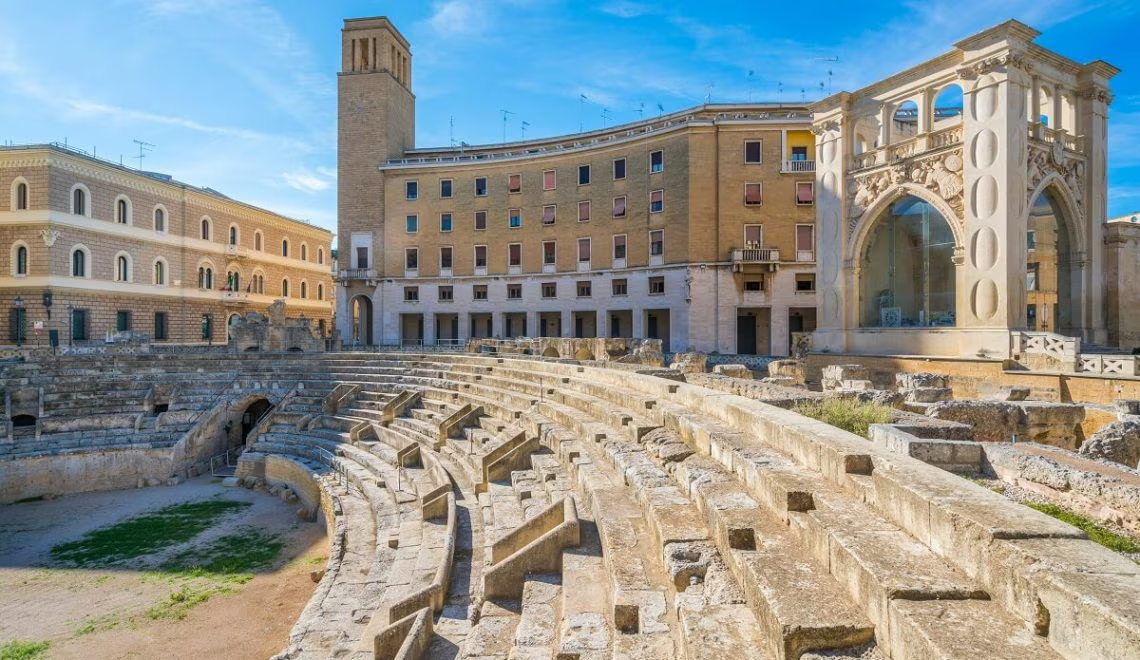
cosa fare a lecce 1140x660 1
Lecce

๐Ÿ“š For the road inward โ€” companion books

โœจ For those who travel like this…

This journey most echoes through:

  • Pisces โ€“ who drift quietly into beauty
  • Cancer โ€“ who travel to feel, not to escape
  • Virgo โ€“ who notice meaning in moments others miss
  • Aquarius โ€“ who crave routes off the map

Espresso Salento still runs nightly from Rome to Lecce. You can explore stops and book through ItaliaRail or Trenitalia.

May your own journey be slow, kind, and lit by small lamps in dark cabins.

โ€œIf you feel like turning this journey into something real โ€” Iโ€™ve gathered practical tips, stays and dreamy stops [here].โ€

When Survival Feeds the Body, but Not the Soul

A reflection for artists, dreamers, and anyone who’s ever worked to live while longing to create.

soul

There is a longing that drifts through people like a quiet current โ€” the desire to live through passion, to be nourished not just by bread, but by inspiration. And yet, in todayโ€™s reality, many of us wake up every morning to walk a path not chosen with love, but with necessity.

Artists in Banks, Musicians Lifting Boxes, Poets Closing Cafรฉs

What makes this ache so profound is that itโ€™s not just a practical dilemma โ€” itโ€™s an existential one. Picture someone carrying a symphony inside them but spending the day listening only to the click of a keyboard. Or a painter who dreams in color but spends her hours arranging lipstick on shelves.

This is the feeling of a life beating beneath the surface โ€” a life possible, but unlived. Often, itโ€™s not a lack of talent that prevents someone from pursuing their art. Itโ€™s the weight of bills. The silence of a family that values “stability” over expression. A world that rewards production but forgets poetry.

Who bears the blame when dreams become a luxury?

Some point to the system โ€” a society built on output rather than creativity. Others carry the scars of unsupportive households, where writing songs or studying astrology was “just a phase.”

But perhaps the truth is more nuanced: weโ€™re exhausted. It’s hard to be free when youโ€™re barely functioning. When survival takes everything youโ€™ve got, thereโ€™s little left for spirit.

Can the soul be fed without applause or stage lights?

Many ask themselves, โ€œAm I lost in a life that no longer reflects who I am?โ€ The answer might lie not in big leaps, but in gentle reclamations โ€” an hour at night, a notebook in your bag, a sketch on your lunch break.

Creativity doesnโ€™t die in chaos โ€” it quietly waits for your return.

The slow awakening of courage

This isnโ€™t a romantic call to quit your job and live beneath the stars. Itโ€™s an invitation to rebalance. To protect a sliver of your week for the things that make you feel alive. To remember that even five minutes of writing or one idea spoken out loud is resistance against the emptiness.

This is for the boy helping his parents on the farm who still writes poems in his head. For the woman working double shifts who dreams of becoming an astrologer. For the mother with no spare time who still keeps a journal full of scents, memories, and soft incantations to herself.

Real life happens in the space between salary and soul โ€” and thatโ€™s where the whole human waits to be seen.

If no one else tells you: your art matters, even when it doesn’t pay. Your passion is still valid, even when called a hobby. And your exhaustion is not a weakness โ€” it’s proof youโ€™ve been holding the world up far too long without help.

You are not alone.

And Yet โ€” There Is Still Time

We donโ€™t always get to choose how life begins.
But we can shape how it continues.

Working to survive doesnโ€™t mean you’ve failed your dream โ€” it means you’re building the ground beneath it. Even the most meaningful passions need a roof over their heads. So yes: answer the alarm, show up where you must, provide for yourself and those you love.

But never mistake โ€œwaitingโ€ for โ€œwasting.โ€

There are people who discover their path at 50.
Others who return to school at 60.
Some who start anew once their children grow.

Your soul is not late โ€” itโ€™s patient.
And life, when honored with intention, will always make space for you.